Retiring the Spreadsheet: How Valparaiso University Modernized Faculty Activity Reporting

For years, Valparaiso University ran its annual Faculty Activity Report (FAR) the way most institutions do, through spreadsheets passed back and forth between faculty, chairs, and deans. For the 2025–26 cycle, this private university moved the entire FAR review process onto Scholarly. As one department chair put it during reviewer training, "This is so much better than the spreadsheets."
One place instead of a dozen documents
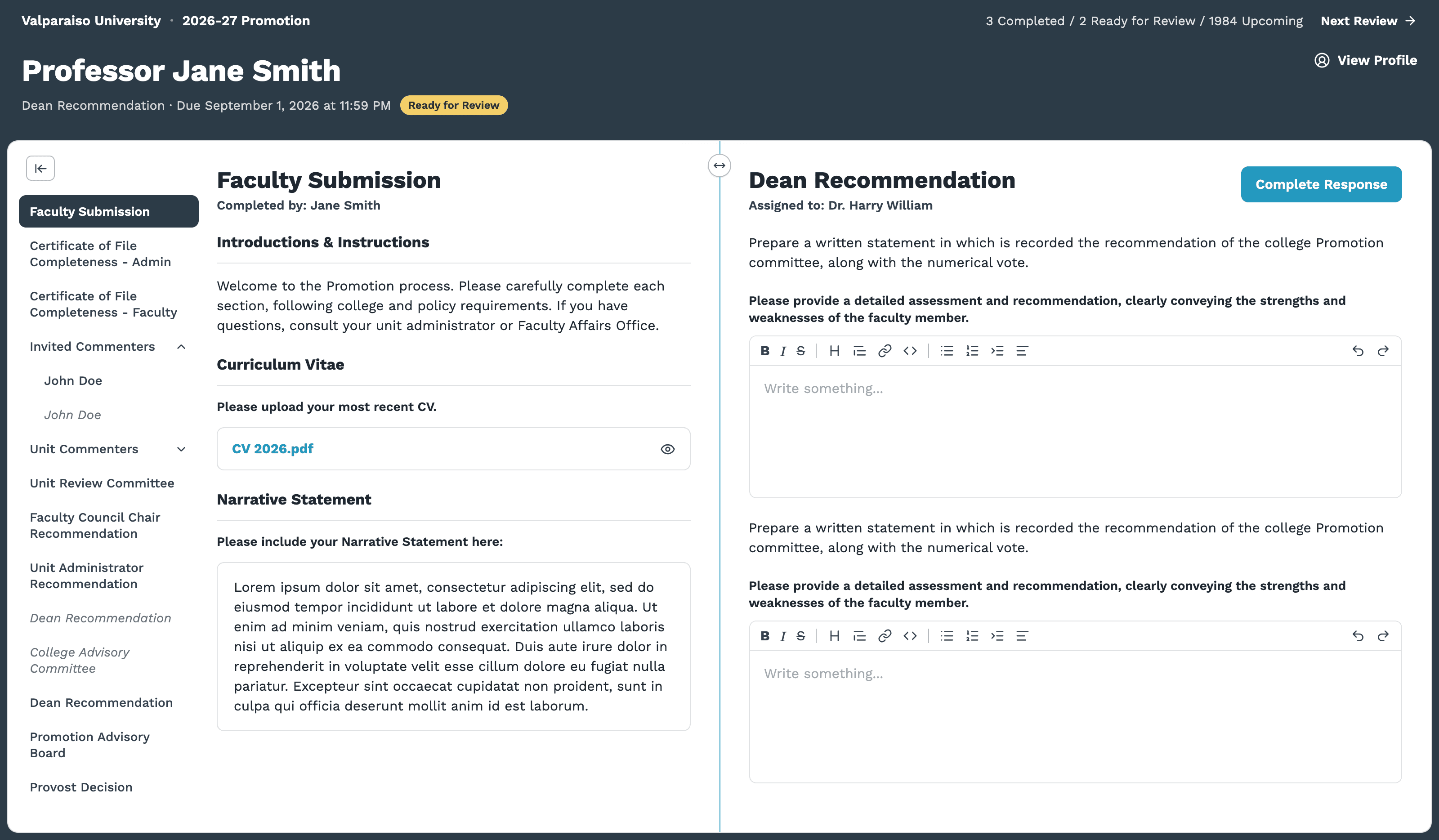
Chairs and deans now open each faculty member's submission in a single view and work through it category by category (e.g. teaching, scholarship, professional development, and service). They record comments and a rating for each without stitching together files or hunting for the latest version. Reviewers noted that the platform surfaces more information than the old spreadsheets and is easier to move through, with one observing that a single faculty report ran to a dozen richly detailed pages.
A few touches made the reviewing itself faster:
Move review-to-review without backtracking. When several reviews are ready, reviewers can advance from one to the next directly, without returning to the dashboard each time.
No save button to worry about. Comments save automatically as they're typed, so reviewers can start jotting notes on a candidate even before that person submits, and pick up where they left off.
Resizable side-by-side view. Reviewers can drag the panel to focus on the faculty member's report or on their own evaluation, rather than toggling between separate documents.
Looking forward, not just back
Valparaiso's faculty activity reporting isn't only an accounting of the past year. As part of the report, faculty set goals for the year ahead. Because the goal-setting fields are configured in Scholarly, the office can guide those entries (for example, scoping them to the correct upcoming year) and review them across the cohort afterward, keeping everyone's goals aligned and comparable heading into the next cycle.
Configured to the institution’s structure
The workflow was shaped around how the different colleges actually operate. The dean-approval step, for example, applies only to the College of Health, due to its organizational structure, and is automatically skipped for all other colleges. Each college follows exactly the path its process requires, from one shared configuration. Deans who wanted to support their reviewers were also granted in-progress visibility, giving them oversight without extra email threads.
What's next
With FAR live and well-received, Valparaiso is extending Scholarly to adjacent processes including a sabbatical application workflow and appointment letters. We are actively building these and are thrilled to help them consolidate their faculty affairs into a single, configurable system.
Want to see how Scholarly can modernize faculty activity reporting at your institution? Get in touch