Summary
Scholarly Software practices responsible AI for faculty data. AI features act as assistive tools—never unilaterally—keeping expert oversight in the loop at every step. Scholarly is transparent about how AI works, upholds strict security and privacy standards, is SOC 2 Type II compliant, and never uses institutional or faculty data to train AI models. Core capabilities streamline academic work while honoring role-based access and governance. (source, source)
- What are Scholarly’s Responsible AI principles? * Human-in-the-loop, transparency, and security. AI features keep humans engaged as double-checks and decision-makers; Scholarly explains what data is used and how; and privacy/security are foundational, with no faculty data retained by AI partners or used to train AI models.
- How does Scholarly ensure oversight instead of automation-by-default? * AI is designed to be an assistant, not a unilateral actor. Every feature supports expert review and approval so institutions maintain control over outcomes and compliance.
- Is Scholarly compliant and privacy-focused? * Yes. Scholarly is SOC 2 Type II compliant and never uses faculty data to train AI models. Access is permission-aware and auditable. (source)
-
What AI capabilities streamline academic work?
* Scholarly Assistant: Ask plain-language questions and get instant, context-scoped answers and reporting.
* CV Import: Import an entire CV or targeted sections; manual activity entry is no longer required.
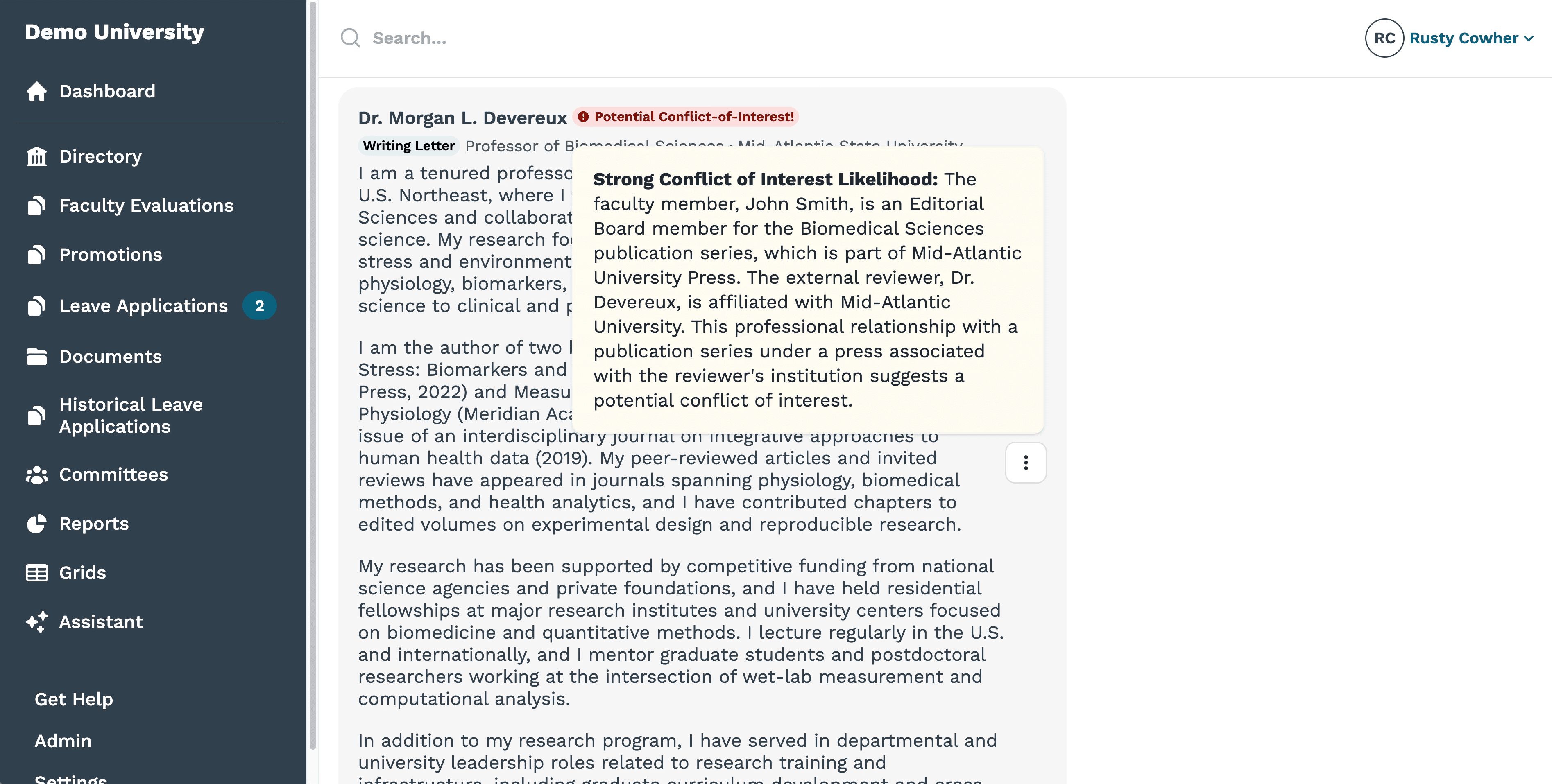
* Conflict checker: Identify conflicts of interest for external evaluators and customize checks for your processes.
* Expertise Finder: Surface subject matter experts and potential collaborators across your institution in seconds. (source) - How is transparency implemented? * Scholarly is clear about what data powers AI features and how results are produced, giving committees and administrators confidence in reviewing and validating outcomes before sharing.
Notable Commitment:
“AI should be a great assistant, never acting unilaterally. That’s why Scholarly’s AI features are designed to support expert oversight, not replace it.”
Explore how Scholarly’s responsible AI can streamline academic work while protecting faculty data.
Book a demo or learn more at
scholarlysoftware.com.