Summary
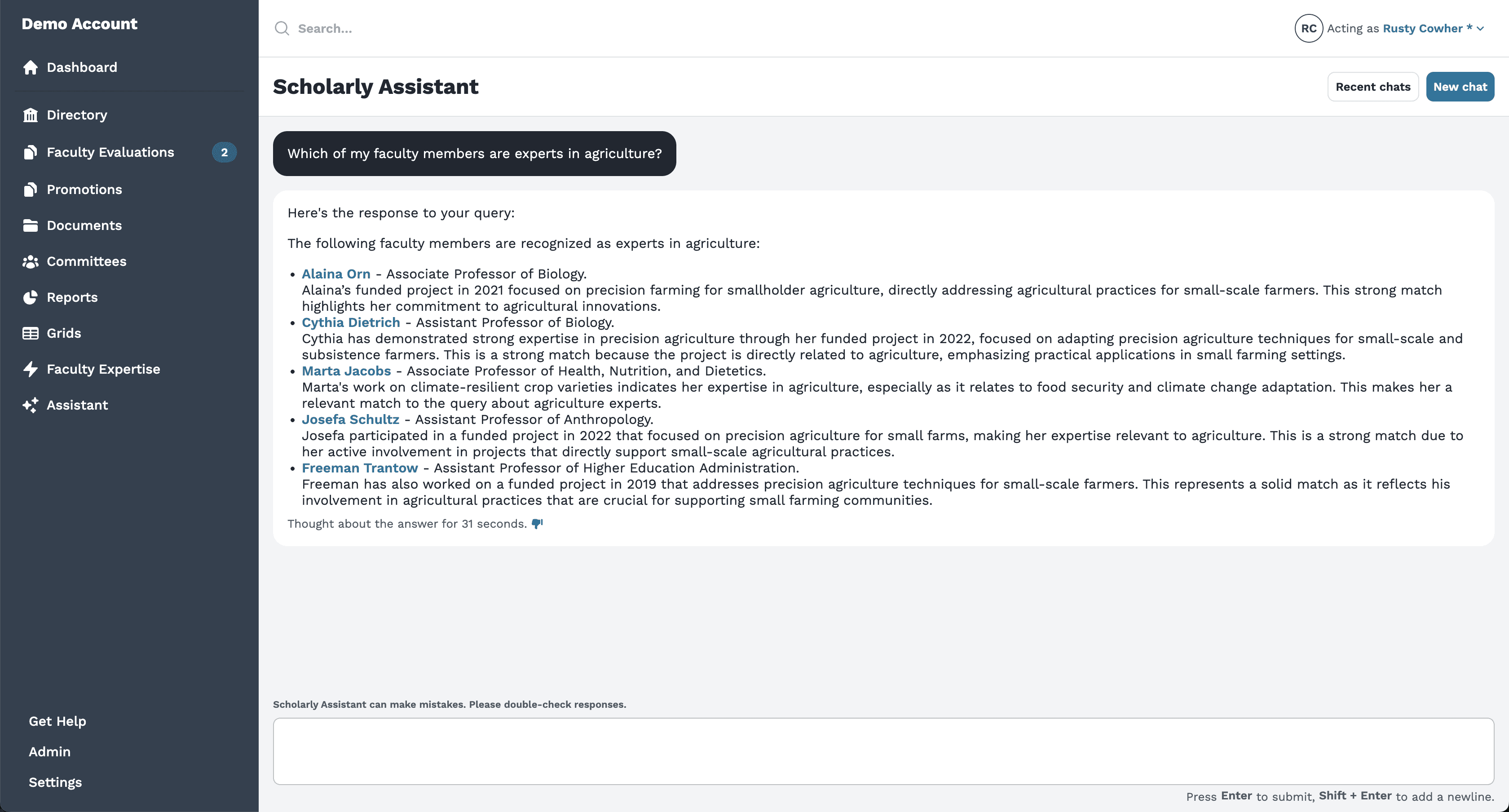
Scholarly Assistant puts the power of faculty data at your fingertips. Ask plain‑language questions and get clear, permission‑aware answers—complete with tables or charts—in seconds, so you can decide faster and with confidence. Scholarly regularly tests models to ensure top performance against rigorous QA standards. The experience is built for trust: every response shows sources and context, and the platform never uses faculty data to train AI models and is SOC 2 Type II–compliant. (source, source)
- What is Scholarly Assistant? * A conversational partner for your institutional data. Ask in natural language and receive permission‑aware answers, summaries, and visuals in seconds—no query building required.
- How does it help me work with data? * Engage intuitively: ask follow‑up questions, refine results, filter by time period or department, and drill into details when you need more context. Get instant visualizations and tabular reports.
- Can I access all my data instantly? * Yes. Scholarly Assistant surfaces your institution‑scoped data immediately and presents it clearly—reducing spreadsheet wrangling and manual report building.
- How does Scholarly keep me in control? * Every response includes sources and context so you can validate, refine, and approve before sharing or export. AI assists; you remain the decision‑maker.
- Is Scholarly Assistant secure and trustworthy? * Designed for transparency, privacy, and verifiable security: role‑based, auditable access; encryption in transit and at rest; SOC 2 Type II compliance; and no faculty data used to train AI models or retained by AI vendors. (source)
Notable Statement:
“Scholarly Assistant is a conversational partner that keeps you in command: ask in natural language and get permission‑aware answers, summaries and visuals from your institutional data in seconds.”
Experience how Scholarly Assistant accelerates confident decision‑making with secure, verifiable insights.
Book a demo or learn more at
scholarlysoftware.com.