How Lewis & Clark College Brought Every Faculty Review Under One Roof
Introduction
Faculty review is rarely one process. A college evaluates its professors in several different ways, each on its own schedule and each with its own rules about who is allowed to see what. Most institutions end up managing that sprawl across shared drives, email, and a few single-purpose tools. This arrangement is hard to keep organized and impossible to keep fully secure.
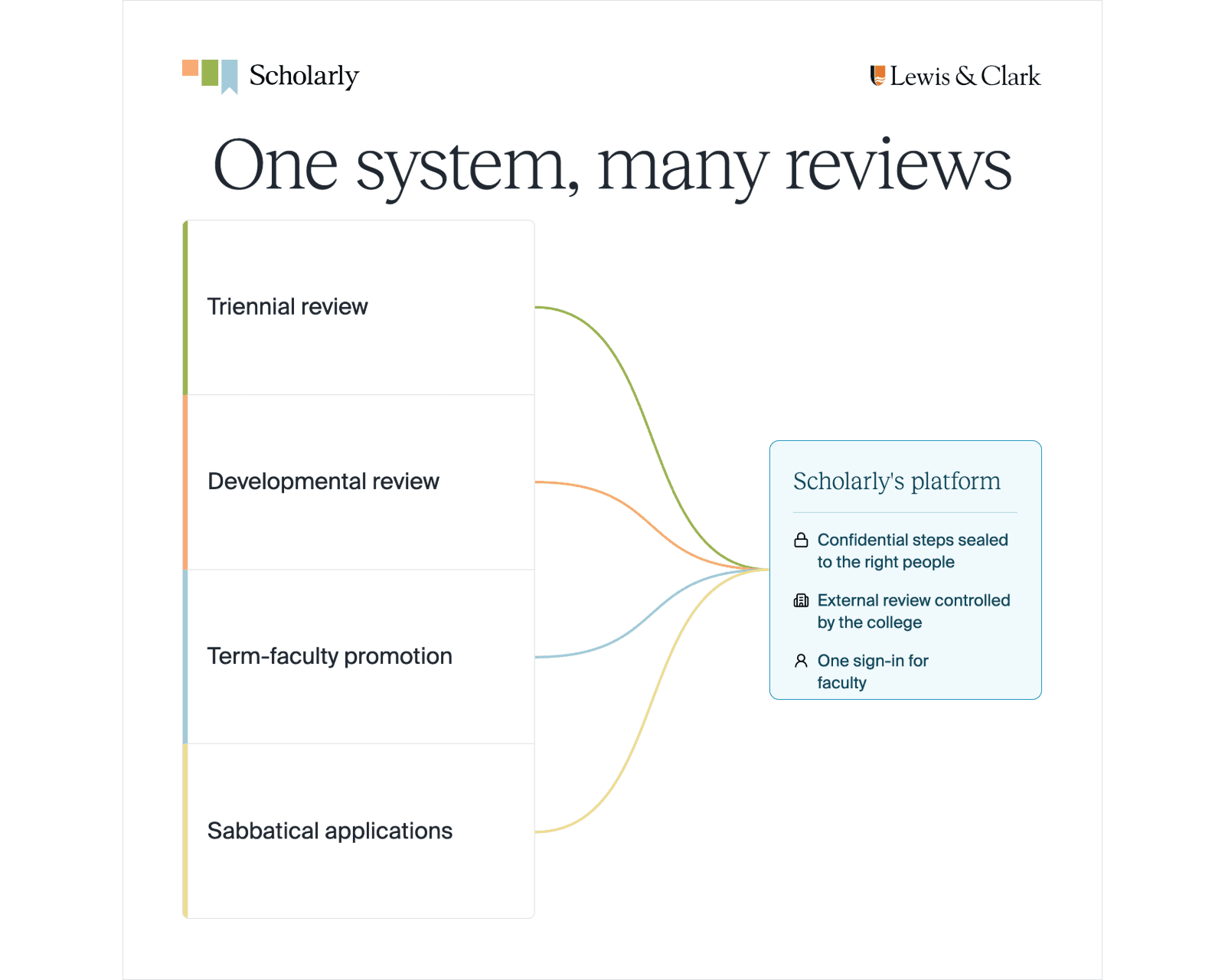
Lewis & Clark College took a different approach, bringing those separate processes into one system with Scholarly. Its recurring triennial reviews, lighter-touch developmental reviews, promotion process for term faculty, and faculty sabbatical applications now run in the same place, each still following its own path. The college has also built out its full promotion and tenure process, including confidential external review, so it is ready to run as soon as the next tenure cases arrive.
Confidentiality the drive-and-folder approach cannot guarantee
The most sensitive materials in a review, especially external evaluations, need to be visible to exactly the right people and no one else. Scholarly gives Lewis & Clark that control at the field and step level. In the promotion and tenure process the college has configured, external reviewers are sequenced to see the candidate's scholarship file and nothing more, not the teaching and service materials, which are submitted separately. Visibility can also change after a step closes, so deliberative materials can be hidden once a committee's review is complete. A shared-drive-and-email setup cannot make these guarantees, because someone always has more access than they should.
External review stays under the college's control
External evaluations are the most sensitive part of a tenure case, so Lewis & Clark wanted that step managed by its own office rather than left open. Scholarly was set up to match how the college prefers to work: the administration oversees the external-review process end to end, reviewers contribute in the form the college expects, and every exchange stays in one coordinated place instead of scattered across inboxes. The result is an external-review step that follows the college's own governance instead of a vendor's default.
The takeaway
Storing documents in one place is easy, and the majority of tools can do it. What is hard, and what a shared drive or a single-purpose system cannot deliver at once, is running several distinct review types side by side, with confidentiality enforced at the field and step levels, and an external-review process the administrator fully controls. That is the combination Lewis & Clark gets from one configurable system, with its promotion and tenure process already built and waiting for its first cohort.
About Scholarly
Scholarly is a modern faculty information system that centralizes faculty data and streamlines the manual work that buries administrators and faculty, so your team spends less time wrangling documents and spreadsheets and more time supporting faculty.