Summary
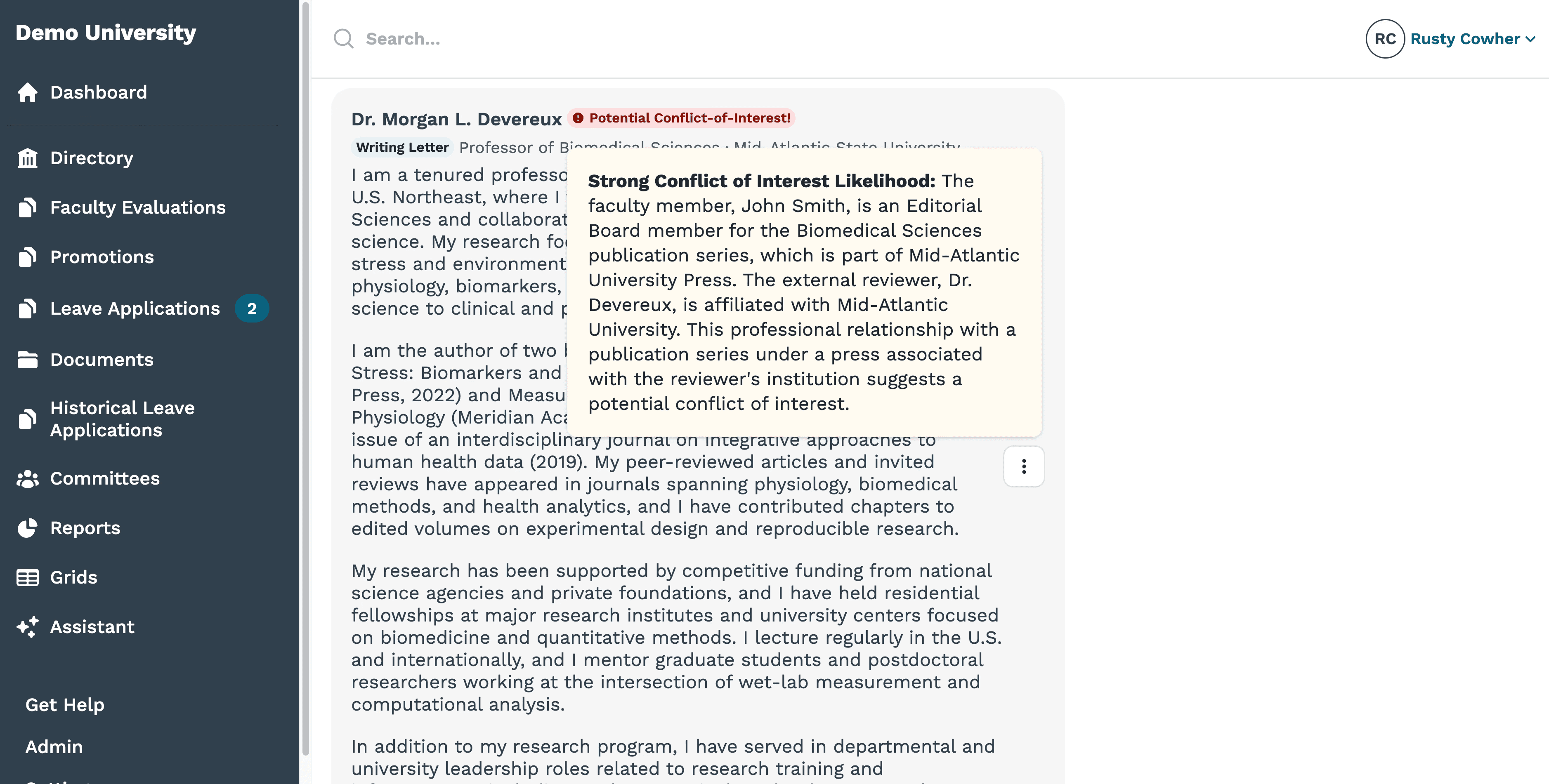
Conflict Checker helps institutions find potential conflicts of interest instantly when nominating external reviewers for promotion or tenure. Scholarly deeply searches the faculty member’s activity to surface signals—such as shared authorships, mentorships, and prior affiliations—so administrators can review with full context. No automated actions are taken; findings are presented for administrative validation and decision-making. Built on responsible innovation and trust: role-based access, encryption, SOC 2 Type II compliance, and no use of faculty data to train AI models. (source, source, source)
- What is Conflict Checker? * An assistive tool that surfaces potential conflicts of interest among nominated external reviewers during promotion and tenure workflows—keeping administrators in control.
-
How does it work?
* 1) Faculty nominate external reviewers for a case.
* 2) Scholarly searches the faculty member’s activities for conflict signals.
* 3) Findings are presented to administrators; no automatic actions are taken. - What signals are checked? * Shared authorships and co-publications, mentorship relationships, previously shared positions or affiliations, and other indicators of potential conflicts relevant to your institution’s policies. (source)
- Why does this matter? * Reviewer selection at scale is time-consuming. Conflict Checker does the leg work—reducing manual searches across multiple cases—while ceding final judgment to administrators for fairness and compliance.
- Is it secure and under my control? * Yes. Every flag shows its underlying inputs so admins can review, validate, and decide. Access is role-based and auditable; data is encrypted in transit and at rest; Scholarly is SOC 2 Type II–compliant; faculty data is not used to train AI models or retained by AI vendors. (source)
Notable Statement:
“Surface potential conflicts across reviewer pools with full transparency—no automated actions, and administrators remain in command.”
See how Conflict Checker streamlines reviewer vetting while preserving administrative oversight.
Book a demo or learn more at
scholarlysoftware.com.